THE DREAM THAT FELL FROM THE SKY
Chapecoense were eleven miles from the greatest night in their history. On November 28, 2016, they never arrived.
5/5/20268 min read

LONG READ · TRAGEDY
The Dream That Fell from the Sky
Chapecoense were eleven miles from the greatest night in their history. On November 28, 2016, they never arrived.
There is a city in the south of Brazil, five hundred miles from the glamour of Rio de Janeiro, where the streets hum with industry and the air carries the smell of a working town. Chapecó, population around 220,000, is not the kind of place that produces football dynasties. There are no gleaming training academies here, no transfer budgets measured in tens of millions, no globally recognised names on the teamsheet. What Chapecó has always had instead is something harder to manufacture: stubborn, collective belief.
In the final months of 2016, that belief carried a small club called Chapecoense to the edge of the most extraordinary achievement in their history. They were eleven miles from the runway when everything ended. Seventy-one people died on a mountainside in Colombia. The dream that had taken four decades to build fell from the sky in a matter of seconds.
What follows is the full story — the rise, the night of November 28th, the survivors, and the long, painful, unfinished business of going on.
ORIGINS
A Club Built on Forty Years of Patience
Chapecoense were founded on May 10th, 1973, in a city that wanted a football club to call its own. The western region of Santa Catarina state was not a traditional footballing heartland — it was an agricultural frontier, settled largely in the twentieth century, far removed from the coastal cities where Brazilian football had always been made and consumed. But the people of Chapecó were not interested in what football had historically given them. They wanted to build something.
The early decades were modest almost to the point of invisibility. A state championship in 1977, a fleeting appearance in the top flight in 1978, and then three decades of drift through the lower divisions. By the 2000s, Chapecoense were playing in the Série D — the fourth tier, the basement of Brazilian professional football — and the idea of continental competition would have seemed not just unlikely but absurd.
The climb began in earnest in 2009. Promotion from Série D to Série C. Then from Série C to Série B. Then, in 2013, the moment that changed everything: a 1–1 draw against Bragantino in Chapecó, and promotion to Série A for the first time in thirty-five years. From the fourth division to the top flight in four seasons. A club rebuilt from the foundations by a community that had never stopped showing up.
But even that was only a prelude.
THE RUN
South America’s Cinderella
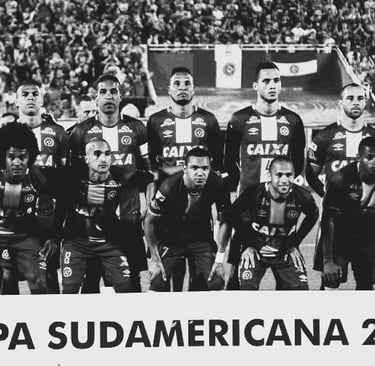
The 2016 Copa Sudamericana — South America’s equivalent of the Europa League — was not supposed to have a story like this in it. The competition had been contested, over the years, by clubs with histories, resources, and continental pedigrees that dwarfed anything Chapecoense could claim. They had no internationally recognised players, no prior experience of the latter stages of a CONMEBOL competition, and a squad assembled on a budget that most rivals would have spent on a single transfer.
What they had was a defensive organisation that was difficult to break down, a collective work rate that wore opponents into mistakes, and a coach in Caio Júnior who understood precisely what his team was and what it was not. Chapecoense did not try to play like a big club. They played like themselves — and it turned out that was more than enough.
They eliminated Cuiabá in the round of sixteen, overturning a first-leg deficit. Then Independiente of Argentina, away from home in Buenos Aires. Then Junior of Colombia. In the semi-finals, they faced San Lorenzo de Almagro — one of Argentina’s most decorated clubs — drew on aggregate, and went through on away goals. The continent had been watching for weeks. Now it stopped entirely.
4
COPA SUDAMERICANA ROUNDS WON
77
PEOPLE ON BOARD FLIGHT 2933
6
SURVIVORS FROM THE WRECKAGE
The Copa Sudamericana final pitted Chapecoense against Atlético Nacional of Medellín, Colombia — a club with genuine continental prestige and a history of silverware. The first leg was scheduled for November 30th in Medellín. The second leg would be played at the Arena Condá in Chapecó. Rival fans petitioned to move the match to the Maracanã so that all of Brazil could witness the occasion. Football journalists across the continent reached for the same word: Cinderella.
On November 28th, 2016, the squad boarded a plane to go and play the biggest match in the history of their club.
THE CRASH
LaMia Flight 2933
The journey to Medellín involved a commercial flight from São Paulo to Santa Cruz de la Sierra in Bolivia, where the squad transferred to a chartered aircraft operated by LaMia — a small Bolivian airline whose functioning fleet consisted, essentially, of a single plane. The aircraft was an Avro RJ85, a British-made regional jet. On board were 77 people: 22 players, 23 staff members, 21 journalists covering the final, two guests, and a crew of four. The atmosphere during the flight was joyful. Players played cards and sang. They were a group of men living the best moment of their careers.
The flight was supposed to include a refuelling stop at Cobija, near the Bolivian border. But the departure from Santa Cruz had been delayed, and Cobija’s airport would have been closed by the time they arrived. The pilot, Miguel Quiroga — who was also a co-owner of LaMia — made the decision to fly directly to Medellín without stopping.
The Avro RJ85 has a maximum range of approximately 1,600 nautical miles. The distance from Santa Cruz to Medellín sits at the absolute outer limit of that figure — with no reserve for circling, for headwinds, for holding patterns, for any contingency at all. International aviation regulations require all commercial flights to carry fuel beyond the planned route for precisely these situations. LaMia 2933 carried none.
As the aircraft approached José María Córdova International Airport outside Medellín, fuel levels became critical. Another aircraft was already on an emergency approach, and air traffic control asked LaMia 2933 to hold. For thirty-six minutes, as the plane circled in the darkness above the Colombian mountains, the pilot did not declare a fuel emergency — a declaration that would have cleared all other traffic and given him immediate landing priority. By the time he finally communicated the severity of the situation, it was too late.
At approximately 10:00 PM local time, with all four engines flamed out and the fuel tanks empty, the aircraft lost power. It struck a mountainside called Cerro Gordo, eleven miles from the runway. There was thunder in the distance. Seventy-one of the seventy-seven people on board were killed.
“For our part, and forever, Chapecoense are champions of the 2016 Copa Sudamericana.”
— Atlético Nacional, statement to CONMEBOL, December 2016
THE SURVIVORS
Six Who Lived
In the wreckage on that Colombian mountainside, six people were found alive. Three of them were Chapecoense players: defender Alan Ruschel, goalkeeper Jakson Follmann, and centre-back Neto. A flight attendant and two other passengers also survived. A seventh person, goalkeeper Danilo, was pulled from the wreckage alive but died in hospital hours later.
Neto later described the final moments of the flight. The atmosphere had been relaxed — players laughing, music playing, the ordinary noise of a group of men in good spirits. Then the lights went out. Silence fell. A flight attendant moved through the cabin and calmly asked passengers to fasten their seatbelts. Moments later, the plane struck the mountain.
Neto woke up in a hospital bed. His father told him there had been an emergency landing, but that he, Follmann, and Ruschel were safe. For a time, he believed the match against Atlético Nacional was still going ahead. It was only when doctors eased him off sedation that they told him what had happened. He later said he could not process it. If he had survived a plane crash, he thought, surely everyone else had too. The idea that he was alive while so many of his teammates were not seemed impossible to hold in his mind.
Jakson Follmann was the last survivor found — pulled from beneath the wreckage after eight hours. He learned in hospital that he had lost his right leg, and that his career as a professional footballer was over. His first reaction, he later said, was gratitude. Better his leg than his life.
Alan Ruschel was told about the crash while sedated, his family showing him phone videos of people cheering for his recovery. He drifted in and out of consciousness for days, not yet able to grasp the scale of what had occurred around him.
All three eventually told their stories in a piece for The Players’ Tribune titled Tomorrow Belongs to God. It remains one of the most powerful first-person accounts in the history of sport.
MOURNING
A World That Stopped
Brazilian President Michel Temer declared three days of national mourning. The Brazilian Air Force deployed three C-130 Hercules transport aircraft to bring the coffins from Medellín back to Chapecó. When the cortège arrived, more than 20,000 mourners packed the Arena Condá. An estimated 80,000 more — roughly half the city’s entire population — gathered in the streets outside in the pouring rain.
Football clubs across South America and beyond changed their crests to black and white. UEFA mandated a moment of respect at all Champions League and Europa League fixtures. FIFA president Gianni Infantino attended the memorial at the Arena Condá. He closed the ceremony with a single sentence: “Today we are all Brazilians. We are all Chapecoenses.”
But the response that has endured came from Atlético Nacional. The Colombian club wrote to CONMEBOL and asked that the Copa Sudamericana title be awarded to their opponents. CONMEBOL accepted. On December 5th, Chapecoense were officially named champions of the 2016 Copa Sudamericana and received the $2 million prize money, along with qualification for the Copa Libertadores. Atlético Nacional were later honoured with CONMEBOL’s Centennial Fair Play Award.
In August 2017, FC Barcelona hosted Chapecoense for a fundraising friendly at Camp Nou. Alan Ruschel captained the side and played the first thirty-five minutes — his first competitive minutes since the crash. When he walked off the pitch, 95,000 people gave him a standing ovation.
INVESTIGATION
Thirty Minutes That Cost Seventy-One Lives
Colombia’s civil aviation authority, Aerocivil, conducted the official investigation. Its findings were unambiguous. The primary cause of the crash was fuel exhaustion. The aircraft had departed Santa Cruz with precisely enough fuel to reach Medellín under ideal conditions — no headwinds, no holding patterns, no delays. This was a direct violation of international aviation regulations, which require all flights to carry fuel reserves for contingencies as a matter of basic operational law.
The pilot, Miguel Quiroga, bore principal responsibility. He had skipped the refuelling stop because Cobija’s airport would have been closed by the time of arrival — but rather than divert to an alternative, he pressed on. When fuel became critical on approach to Medellín, he failed to declare a fuel emergency for more than thirty minutes. LaMia’s insurance policy had also lapsed, and had never covered flights to Colombia in the first place.
The Bolivian government suspended LaMia’s operating licence. Criminal charges were brought against five individuals connected to the airline and Bolivian aviation authorities. Brazilian prosecutors cleared Chapecoense’s club officials of negligence in hiring LaMia — the airline had flown multiple football delegations for international competitions without incident in the preceding period.
The crash was, in the coldest possible terms, entirely preventable. A refuelling stop of approximately thirty minutes would have saved seventy-one lives.
AFTERMATH
Rebuilding from Ashes
In the immediate aftermath, Brazilian football rallied around Chapecoense with practical offers of support. Rival clubs offered free player loans. There were petitions to the Brazilian FA to exempt the club from relegation for three years. Chapecoense declined the protection. Their leadership said the club would rebuild on its own terms, even if the road was longer and harder as a result. It was, recognisably, the same stubborn pride that had driven the original climb from the fourth division.
With a squad assembled from free signings, loan players, and promoted youth team members — as well as survivors Alan Ruschel and Neto, both of whom returned to competitive football — Chapecoense entered the 2017 Copa Libertadores as Copa Sudamericana champions. In their first match, away to Zulia of Venezuela, they won. It was a small result in the context of continental football. In every other context, it was enormous.
The years that followed were defined by cycles of struggle and recovery. Relegated from Série A in 2019. Back in the top flight in 2021. Relegated again. In November 2025, nearly nine years to the day after the crash, Chapecoense secured promotion back to the Série A, finishing third in the Série B campaign. As of 2026, they are in the top flight once more — sitting in the lower half of the table, fighting the battles that small clubs always fight against vastly wealthier opponents. But they are there.
Seventy-one people boarded a plane to play in the biggest game their club had ever known. A pilot’s decision and thirty minutes of silence on a radio frequency stole all of it. What remains is a club that refused to die.
FURTHER READING
Alan Ruschel, Jakson Follmann & Neto — Tomorrow Belongs to God, The Players’ Tribune (2017)
Aerocivil — Official Investigation Report, LaMia Flight 2933 (2017)
CONMEBOL — Official Statement on the 2016 Copa Sudamericana, December 5, 2016